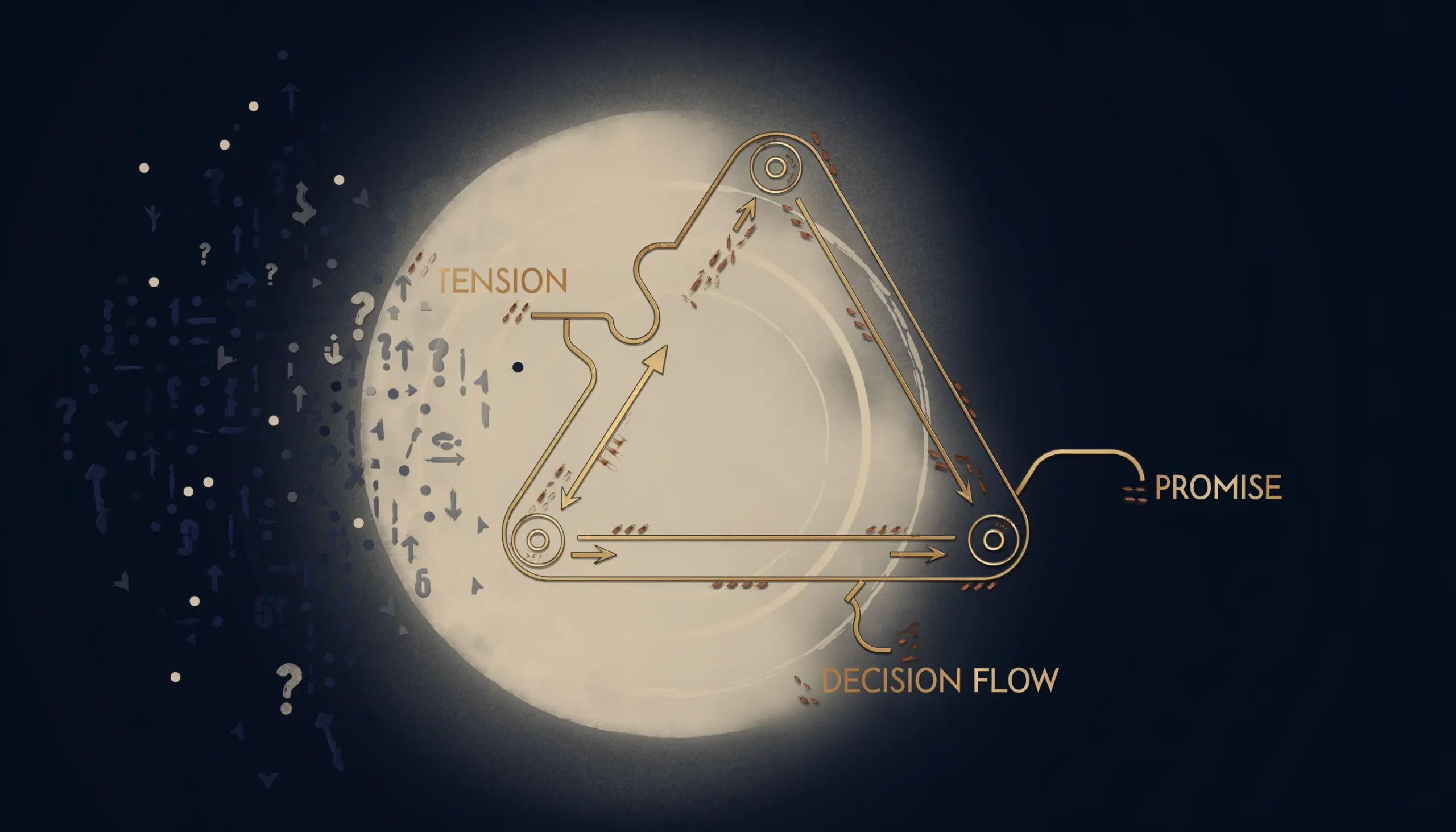


Early traction is one of the most deceptive moments in business. It feels like proof that the hard part is over. People are buying. The market is responding. Attention is turning into revenue. The founder finally has evidence that something is working. Because of that emotional relief, many founders interpret traction as a sign that they should simply keep doing more of whatever produced the initial response.
That reaction is understandable, but it is often strategically incomplete. Early traction is not only a validation moment. It is a structural warning. It tells the founder that the business is about to experience pressure. More customers, more expectations, more delivery complexity, more operational decisions, and more opportunities for inconsistency all begin arriving at once. If there is no underlying structure, the very traction that looked like success becomes the thing that destabilizes the business.
This is why the post-launch phase matters so much. After early traction arrives, the founder’s job changes. The question is no longer only whether the market will respond. The question becomes whether the business can hold, repeat, and extend that response without creating chaos. At that stage, structure becomes more important than excitement.
Early traction validates demand, not stability
One of the biggest strategic mistakes after launch is assuming traction proves the entire business model is sound. In reality, traction usually proves something narrower. It shows that a specific message, offer, audience, or moment of attention has created a response. That is valuable, but it is not the same thing as durable business stability.
A founder can have strong early sales and still have weak delivery, unclear pricing logic, fragile operations, poor information flow, and no coherent path for future customer growth. In that condition, traction is real, but architecture is still thin. The business has discovered how to attract movement before it has learned how to support continuity.
The first post-launch responsibility is offer clarification
Once traction appears, founders often feel pressure to expand immediately. They want additional offers, more channels, more campaigns, and more volume. But the first responsibility is usually clarification, not expansion. The business needs to understand exactly what is being bought, why it is being bought, what result the customer expects, and what part of the offer is actually producing the conversion.
This matters because early traction can hide ambiguity. Customers may buy for slightly different reasons than the founder assumes. They may be attracted by one part of the promise while the business is organized around another. If the founder scales that ambiguity, the business becomes harder to message, harder to deliver, and harder to improve. Clarifying the core offer after traction is how the founder prevents early momentum from becoming later confusion.
Delivery structure must be built before growth magnifies inconsistency
The next pressure point is delivery. Many businesses launch with enough flexibility to satisfy the first group of buyers through founder effort, improvisation, and personal care. That can work temporarily. But traction increases the number of interactions, and volume quickly exposes every unclear step.
This is why core delivery should be made explicit as early as possible after traction begins. Customers need a visible path through the transformation, and the business needs a reliable mechanism for producing that transformation repeatedly. Without that clarity, growth creates variation where reliability should exist. Clients receive different experiences, internal decisions become harder to make, and the founder becomes the person constantly patching the gaps.
Monetization architecture should follow traction, not just marketing optimism
Another structural task after early traction is deciding how revenue should be organized. Many founders delay this because it feels advanced, but it becomes necessary sooner than they expect. Once an offer begins attracting demand, the business has to decide whether that offer is an entry point, a core offer, a premium layer, or a short-term opportunity that should not become central.
Without that decision, monetization becomes reactive. The founder adds whatever seems sellable in the moment, responds to custom requests, and slowly builds a revenue model out of scattered transactions. That may create short-term cash, but it usually weakens strategic coherence. Post-launch structure requires deciding how early demand fits into a broader revenue pathway, not just celebrating that revenue exists.
Architecture Intensive
Strategic diagnostic. Structural alignment. Documented roadmap.
We evaluate your positioning, monetization, and infrastructure as one integrated system and deliver a precise implementation plan within 48 hours.
Book Architecture Intensive
Information systems matter earlier than most founders think
Many founders postpone documentation, process clarity, and knowledge capture because these tasks feel administrative compared with selling or delivering. But early traction is exactly when information systems begin to matter. Questions repeat. Customer patterns emerge. Delivery decisions reveal friction. Sales objections become easier to categorize. Operational surprises start producing lessons the business should retain.
If that knowledge remains trapped in the founder’s memory, the business becomes increasingly dependent on improvisation. If it is captured and organized, the business starts developing institutional intelligence. This is one of the earliest differences between a business that matures and a business that keeps rebuilding itself from scratch.
Traction should trigger simplification before expansion
There is a strange pattern that appears in many post-launch businesses. As soon as something works, the founder becomes more ambitious and more scattered at the same time. They want new offers, broader positioning, multiple funnels, more content categories, and more delivery variations. The energy of traction creates appetite for multiplication.
But multiplication too early usually creates fragility. The business has not yet earned complexity. The more strategic response is often simplification: refine what is already working, remove avoidable variation, make the offer easier to explain, make delivery easier to repeat, and make the next customer journey more coherent than the last one. Simplification after traction is not conservative. It is how businesses prepare for scalable growth.
Post-launch structure protects founder capacity as much as customer experience
There is also a founder-level consequence here. Without post-launch structure, every sign of growth increases direct founder involvement. More sales lead to more exceptions, more custom delivery, more clarification requests, more pricing decisions, more support questions, and more internal complexity. The founder begins to experience traction as pressure rather than leverage.
When structure is built early, the opposite becomes possible. The business starts absorbing demand with more intelligence and less drama. Customers receive a clearer experience, the team has better reference points, and the founder can focus more on strategic refinement than on operational rescue. This is why post-launch structure is not a bureaucratic exercise. It is the mechanism that converts momentum into usable capacity.
Conclusion
After early traction arrives, founders should stop thinking only like validators and start thinking like architects. The immediate task is not to chase more motion at any cost. It is to build the structures that make demand repeatable, delivery reliable, revenue coherent, and growth survivable. Traction is not the finish line. It is the moment the business becomes structurally accountable for what it has proven.