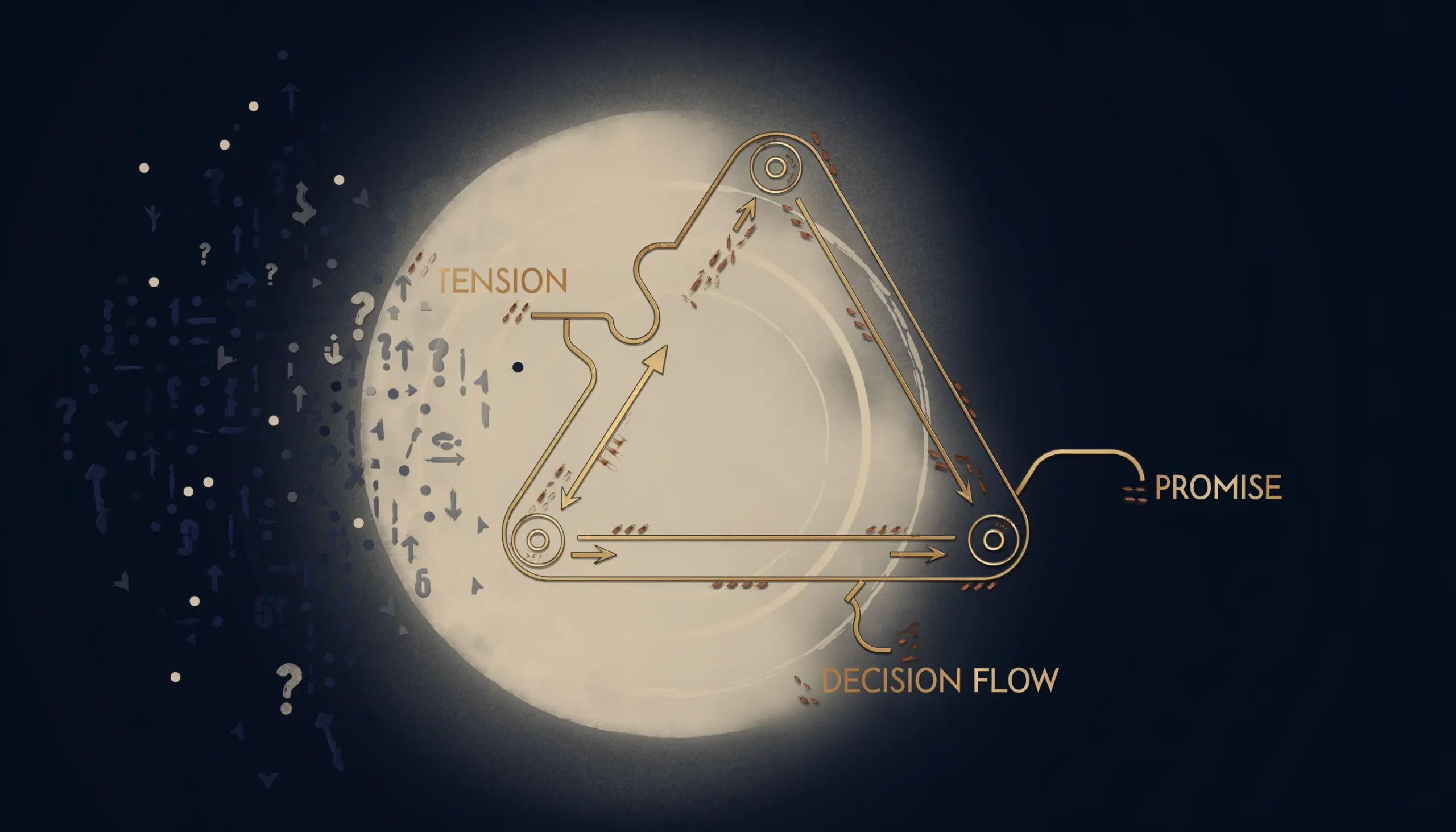
Many businesses say they want to productize, but what they actually mean is that they want the efficiency of standardization without surrendering the flexibility of custom work. That ambition is understandable. It is also where a great deal of structural confusion begins.
A service business and a productized service are not simply different packaging styles. They are different operating logics. One is built around interpretation, variation, and tailored judgment. The other is built around repeatability, bounded scope, and controlled delivery. When founders try to combine both logics without deciding which one governs the business, they produce a monetization structure that feels promising at the surface and unstable underneath.
This is why the choice matters earlier than most founders think. It determines not only how the business sells, but also how it delivers, prices, scopes, and protects margin. Delaying the decision usually feels like staying open. In practice, it often means the business keeps absorbing complexity without earning the structural advantages of either model.
Custom service and productized service solve different strategic problems
A custom service model is strongest when the value depends on diagnosis, adaptation, and founder judgment. It allows the business to respond to complex realities that cannot easily be standardized. This model often supports premium pricing because the client is paying for interpretation, not only execution.
A productized service solves a different problem. It reduces uncertainty for the buyer and repeatability risk for the business. The scope becomes clearer, delivery becomes more consistent, and the economics become easier to model. What the buyer loses in flexibility, they often gain in speed, confidence, and simplicity.
The danger of the undefined middle
The trouble begins when a business markets itself like a productized service but continues delivering like a bespoke consultancy. In that structure, the promise suggests clarity while the operating reality remains custom. Pricing starts to wobble because the business wants standardized economics on top of variable effort. Delivery strain increases because every engagement quietly reintroduces exceptions.
This undefined middle is attractive because it appears to combine the best of both worlds. But strategically, it often produces the opposite. The business gives up some of the pricing power of custom work while also giving up the operational simplicity of productization. It becomes harder to explain, harder to scope, and harder to scale cleanly.
Productization is not simplification for its own sake
Some founders resist productized services because they believe standardization will flatten the value they provide. That risk exists if productization is handled superficially. But real productization is not the removal of expertise. It is the structuring of expertise into a more repeatable exchange.
A strong productized service decides where interpretation belongs and where it does not. It determines which variables can be controlled without reducing outcomes. It creates constraints that protect both delivery quality and commercial clarity. In that sense, productization is not about becoming generic. It is about becoming economically coherent.
The founder must choose where variation is allowed to live
Every business contains variation somewhere. The structural question is where that variation should reside. In a custom service, variation lives throughout the engagement. In a productized service, variation may live in qualification, in limited strategic inputs, or in how the standardized process is applied, but not in unlimited scope.
If the founder does not decide this deliberately, the client will decide it implicitly. That is usually when margins erode. The business sells a bounded offer, then delivers an expanding one. What looked scalable from the outside turns into hidden customization inside the operation.
The monetization choice shapes the whole business architecture
This is not only a sales or offer design question. It changes the architecture of the company. Sales conversations, pricing confidence, onboarding, team design, process documentation, and quality control all behave differently depending on whether the core logic is custom or productized.

Architecture Intensive
Strategic diagnostic. Structural alignment. Documented roadmap.
We evaluate your positioning, monetization, and infrastructure as one integrated system and deliver a written Strategic Audit Report, including a phased priority roadmap, delivered within 48 hours.
A business that stays undecided too long often experiences recurring tension between growth and delivery. The founder wants simpler sales but keeps making custom promises. They want better margins but allow each engagement to redefine the work. They want delegation but retain a model that depends heavily on their personal interpretation. None of these tensions are random. They are structural consequences of an unresolved monetization choice.
Growth becomes cleaner when the governing logic is explicit
Once the business decides which model leads, many downstream decisions become easier. If the business remains custom, it can price and position around tailored judgment with more honesty. If it becomes productized, it can tighten scope, clarify outcomes, and build delivery around repeatable standards.
What creates friction is not choosing one logic or the other. What creates friction is asking a single business to obey both at once. A founder does not need to eliminate nuance. They need to decide which structure the nuance serves.
Conclusion
The choice between service business and productized service is not cosmetic. It determines how value is translated into revenue and how delivery pressure accumulates over time. When founders delay the choice, they often end up carrying the cost of both models without capturing the strength of either one. The business becomes easier to grow when its governing logic is finally made explicit.