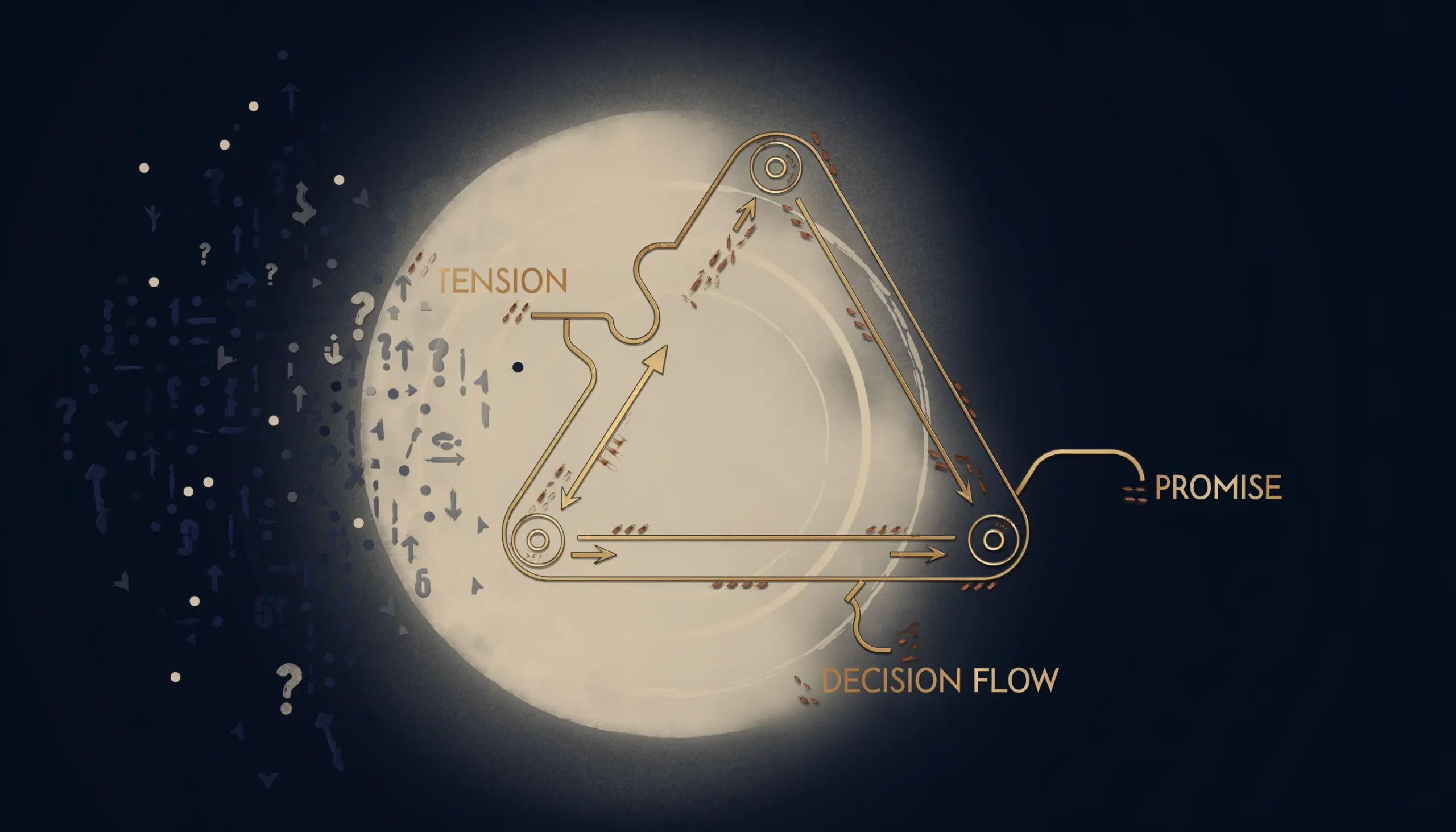
When delivery starts to feel messy, founders usually look downstream for the answer. They audit workflows, add software, tighten project management, and search for better delegation. Sometimes those changes help. Often they do not help enough, because the disorder was not created by execution alone.
A surprising amount of operational friction originates earlier, inside the way the business has packaged what it sells. If the offer is loosely defined, overly customized, or commercially attractive only because it quietly absorbs endless variation, the operational team inherits a problem no process can fully clean up. The business is not failing to operate a clear model. It is trying to operate an unclear one.

Architecture Intensive
Strategic diagnostic. Structural alignment. Documented roadmap.
We evaluate your positioning, monetization, and infrastructure as one integrated system and deliver a written Strategic Audit Report, including a phased priority roadmap, delivered within 48 hours.
This is why some businesses keep improving systems while still feeling overloaded. They are solving for smoother delivery without first asking whether the thing being delivered has been structured in a way the business can execute consistently. The pressure shows up in operations, but the cause often begins in monetization architecture.
Packaging determines what operations must repeatedly absorb
Every offer carries an implied operating model. It tells the business what kind of work will repeat, how much variation will be tolerated, what level of judgment each engagement requires, and where the boundaries of delivery are meant to sit. Even when those assumptions are not written down, they still shape what the backend must carry.
That is why packaging is not a sales veneer placed over the real business. It is one of the mechanisms that defines the real business. If the offer promises flexibility without limit, customization without discipline, or outcomes without a stable delivery logic, the operations layer will be forced to manage the instability later. The problem is not that the team lacks discipline. The problem is that the business has sold variability as if it were a scalable product.
Delivery chaos often begins as commercial ambiguity
Founders sometimes believe the market requires a loose offer because buyers want to feel accommodated. There is some truth in that, but accommodation has structural consequences. Every unbounded promise, every vague scope line, and every offer designed to feel easy to buy at the front end may create hidden difficulty on the back end.
This is where operational mess takes shape. Clients expect slightly different outcomes, projects need repeated reinterpretation, exceptions become normal, and internal coordination becomes heavy because the business has not created a stable enough unit of delivery. What operations experiences as complexity is often monetization passing down unresolved ambiguity.
Weak offer boundaries create recurring exceptions that systems cannot eliminate
Operational systems work best when the business is solving a problem that recurs in a recognizable form. Process gains power when the work has enough pattern stability to support standard judgment, predictable sequencing, and cleaner handoffs. When every delivery instance arrives as a special case, systems lose leverage because the business is asking them to organize exception management rather than repeatability.
This is why messy operations frequently coexist with sincere process improvement. The founder documents steps, builds templates, adds meetings, and installs tools, but the exceptions keep proliferating because they are not accidental. They are baked into the commercial structure. The offer was sold as if each client could reshape the model. Operations can only do so much with that inheritance.
A business cannot standardize the back end of a front end that keeps changing shape
One of the clearest signs of a packaging problem is when the business keeps trying to create stable execution around an unstable promise. Teams are asked to deliver with precision, but the offer itself keeps shifting in scope, format, involvement level, or success definition. Under those conditions, operations becomes reactive by design.
This is why some companies feel busy even when they are not growing dramatically. The work is not simply large. It is structurally uneven. The business keeps re-solving the same categories of delivery problem because the front end never established a clean enough agreement about what is actually being bought.
Better operations usually begin with a more disciplined value exchange
When founders hear that packaging may be the issue, they sometimes interpret it as a recommendation to become rigid or impersonal. That misses the point. Strong packaging does not reduce value. It makes value more reliable. It gives the customer a clearer understanding of the transformation, gives the business a clearer understanding of the commitment being made, and creates conditions under which quality can be delivered without constant reinvention.
That reliability matters commercially as much as operationally. A well-packaged offer is easier to explain, easier to price, easier to fulfill, and easier to improve over time. It allows the business to see what is repeatable, what needs to remain premium and customized, and where additional layers of support should exist. In other words, disciplined packaging does not merely tidy operations. It clarifies the economic model.
Repeatability is not sameness. It is controlled variation
Founders often resist tighter packaging because they assume repeatability means stripping out nuance. But repeatability does not require identical delivery in every case. It requires a strong enough structure that variation happens inside clear boundaries rather than in place of them. The business still adapts. It simply adapts from a stable base.
This distinction is what allows sophisticated service businesses to scale without becoming generic. They do not remove judgment where judgment is needed. They remove ambiguity where ambiguity is expensive. Once that happens, operations can become lighter because it is supporting a better-shaped offer rather than compensating for a chaotic one.
Many operations problems are really decisions about what business you are trying to run
A founder-led advisory model, a productized service, and a hybrid consulting business do not create the same kind of operational load. Each asks for a different relationship between customization, expertise, margin, staffing, and process. If the offer structure keeps borrowing from multiple models without choosing one clearly, the business experiences stress that looks operational but is actually architectural.
This is why operational mess should be read diagnostically. It may be signaling that the business has not decided how standardized it wants to be, what level of buyer it is built to serve, or where premium customization truly belongs. Without those decisions, process becomes a series of patches applied to a model that still lacks a firm commercial shape.
Cleaner delivery is usually a downstream effect of clearer monetization
When the value exchange becomes more disciplined, delivery often stabilizes faster than expected. Handoffs improve because the promise is clearer. Resourcing improves because the work is easier to predict. Margin improves because the business is no longer quietly absorbing unpriced complexity. What appears to be operational relief is really structural relief.
That is why founders should be careful about treating operations as an isolated layer. Systems matter, but systems are always serving a business model. If the model sells confusion, the systems will inherit confusion. If the model sells a more coherent form of value, operations finally has something it can support reliably.
Conclusion
Operational mess is often blamed on weak systems, but many of its roots sit upstream in the way the offer was packaged and sold. When scope, variation, and value boundaries remain loose, operations absorbs the instability later. Cleaner delivery usually begins not with more process, but with a more coherent monetization structure that gives process something stable to support.