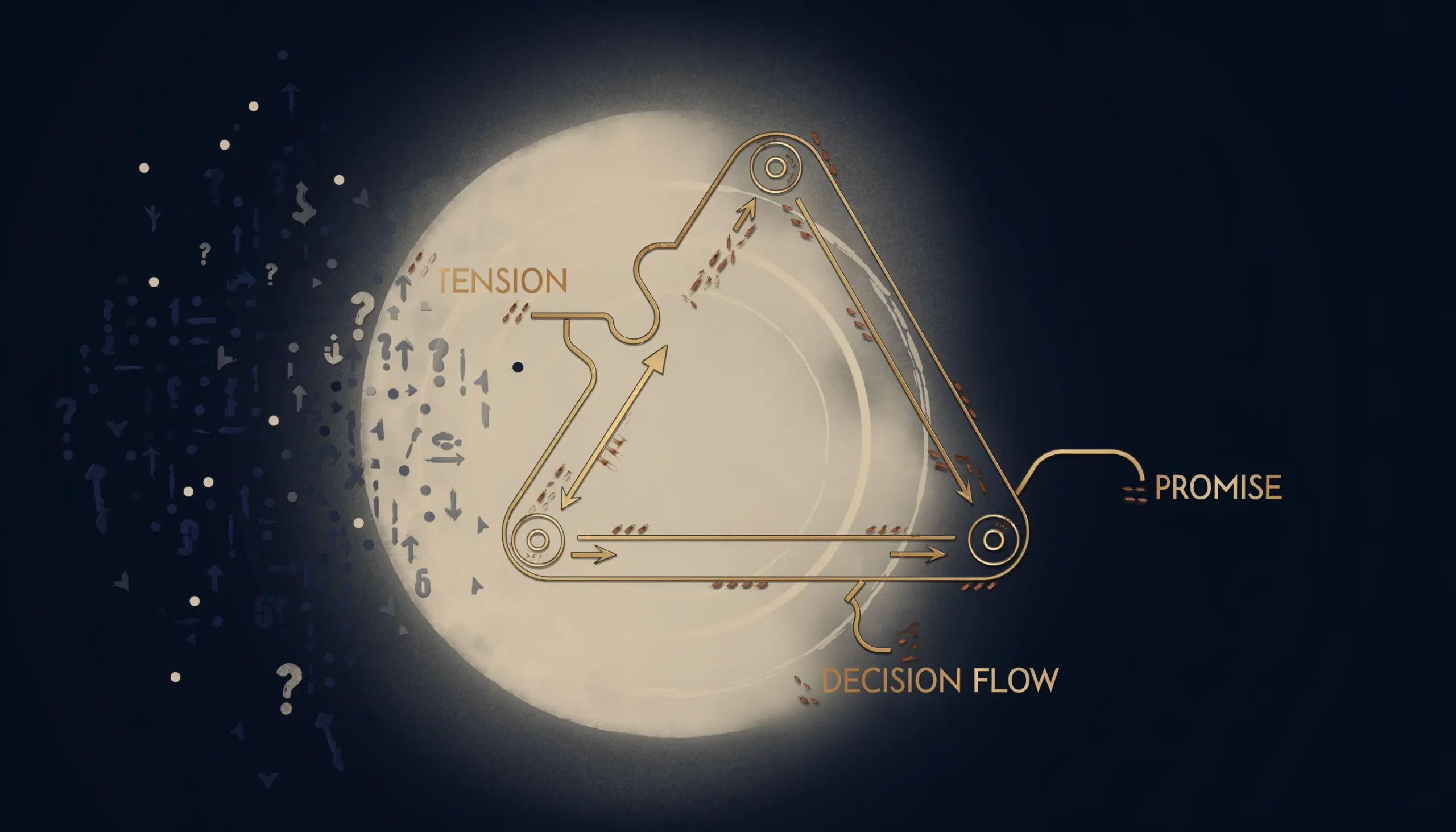
Strategic Positioning determines pricing power, client quality, and long-term defensibility. It is not aesthetic preference or messaging refinement. It is the deliberate choice of how a company competes, whom it excludes, and what economic role it occupies in the market.
Many businesses treat positioning as a communication adjustment. They refine language, update visual identity, or modify headlines. These actions may influence perception temporarily, but they do not resolve the structural question: what economic territory is this company built to control?
Positioning is not a creative decision. It is a strategic allocation of competitive energy.
Positioning Defines the Terms of Competition
Every market operates according to implicit criteria. Buyers evaluate alternatives using standards that determine price tolerance, risk assessment, and authority recognition. Positioning establishes the standards by which a company wishes to be judged.
When positioning is undefined, the market imposes its own criteria. Price becomes the dominant variable. Differentiation weakens. Acquisition becomes more expensive because the company competes on crowded ground.
Clear positioning narrows comparison. It defines the dimension of value on which the company intends to compete. This choice determines whether it competes on price, specialization, exclusivity, complexity, speed, intellectual rigor, or strategic integration.
Competitive strategy begins with this decision. Everything that follows, including Monetization Architecture design and infrastructure investment, derives from it.
Pricing Power Emerges from Positioning Clarity
Pricing is often approached as a tactical adjustment. Increase rates gradually. Test price sensitivity. Offer discounts to reduce friction. These techniques operate at the surface.
When positioning articulates a precise economic role, pricing reflects authority rather than negotiation. The company is not merely offering services. It is occupying a defined competitive stance that justifies valuation.
Ambiguous positioning weakens this authority. If a company cannot clearly articulate the strategic territory it controls, pricing becomes defensive. Discounts compensate for uncertainty. Margin erosion follows.
Clear positioning aligns perceived value with economic design. It reduces the need to persuade because it defines the framework in which evaluation occurs.
Client Quality Reflects Competitive Stance
The quality of clients a company attracts is rarely random. It reflects how the company presents its competitive role.
Positioning determines the expectations clients bring into the relationship. If the brand signals accessibility without boundary, it attracts opportunistic demand. If it signals specialization with discipline, it attracts buyers seeking strategic depth.
This is not about exclusivity for its own sake. It is about alignment between the economic structure of the business and the evaluation criteria of its clients.
Poor alignment generates friction. High-touch delivery paired with price-sensitive clients. Premium pricing paired with undefined authority. Operational strain paired with unclear scope boundaries.
Strategic positioning filters demand before it enters the system. It ensures that monetization and delivery are reinforced by the type of client acquired.
Exclusion Is a Structural Necessity
Positioning inherently involves exclusion. A company cannot occupy every competitive territory simultaneously.
Many founders resist this constraint. They expand scope to increase perceived opportunity. They broaden messaging to capture larger markets. In doing so, they dilute strategic clarity.
Economic strength requires constraint. By defining what the company is not designed to do, positioning protects focus. It concentrates expertise. It preserves authority.
Exclusion reduces noise in the decision environment. It clarifies who the company exists to serve and under what terms. This clarity strengthens competitive defensibility over time.
Authority Is an Economic Asset
Authority is often discussed as perception. In practice, it functions as an economic multiplier.
When a company occupies a clearly defined competitive position, its authority compounds. Content reinforces stance. Client outcomes reinforce pricing logic. Systems reinforce delivery expectations. Over time, the company becomes associated with a specific domain of competence.
This association reduces acquisition friction. It increases trust velocity. It stabilizes revenue. Authority becomes embedded in market memory.
Authority without positioning is unstable. Positioning without authority is inert. Together, they form the economic backbone of sustainable scale.
Positioning Precedes Monetization and Infrastructure
Positioning determines what the company is built to sell. Monetization formalizes how it sells. Infrastructure operationalizes both layers.
When positioning is treated as a branding exercise rather than a structural decision, monetization becomes reactive. Infrastructure becomes fragmented. Systems compensate for strategic ambiguity.
Economic coherence begins with competitive clarity. Only once positioning is precisely defined can revenue architecture and operational systems reinforce rather than distort it.
Positioning is not the decorative layer of business. It is the directional layer.
Conclusion
Positioning is an economic decision that shapes how a company competes, earns, and sustains authority over time.
It defines the criteria by which it is evaluated. It determines pricing power. It influences client composition. It establishes defensibility.
When treated as a branding exercise, positioning remains cosmetic. When treated as a competitive allocation of strategic intent, it becomes structural.
Businesses do not scale because they communicate attractively.
They scale because they compete deliberately.

Architecture Intensive
Strategic diagnostic. Structural alignment. Documented roadmap.
We evaluate your positioning, monetization, and infrastructure as one integrated system and deliver a written Strategic Audit Report, including a phased priority roadmap, delivered within 48 hours.