
CATEGORY
Positioning
Positioning examines how companies define the intellectual territory they occupy in the market and communicate their distinctive perspective.
INSIGHTS
Related Articles
 Diagnose whether stalled growth comes from positioning or monetization before narrowing your audience or expanding your offers.
- Being distinctive earns attention. A durable market advantage comes from a difference that keeps changing how buyers understand and decide.
- Sophistication creates customer confusion when a business exposes its internal complexity instead of organizing it around a clear decision.
- Sales conversations become strategic intelligence only when the business turns repeated buyer signals into owned, testable decisions.
- Visibility becomes commercially useful when it reinforces a clear position, a coherent offer and an understandable path to purchase.
 The market you compete inside determines which part of your business must become unmistakably clear.
- A growth plateau usually appears when the first growth structure stops compounding, not when the market suddenly stops caring.
- More marketing rarely fixes an offer the business still does not understand well enough to structure, price, or explain clearly.
- Founders misdiagnose growth when they confuse genuine market friction with friction created by weak strategic framing.
- Many founders do not have a consistency problem. They have a clarity problem that repetition keeps amplifying.
- Broad positioning often feels safer, but it usually delays the market feedback founders need to sharpen demand, relevance, and trust.
- Strategy matters only when it changes what a founder prioritizes, refuses, and commits to in real decisions.












Key Concepts
In Positioning
These concepts describe the strategic foundations explored throughout the Insights section. Each page defines a principle that influences how companies design their market position, revenue model, and operational structure.


The structural design of positioning, monetization, and infrastructure that enables a company to grow sustainably and maintain strategic control.
Strategic Positioning
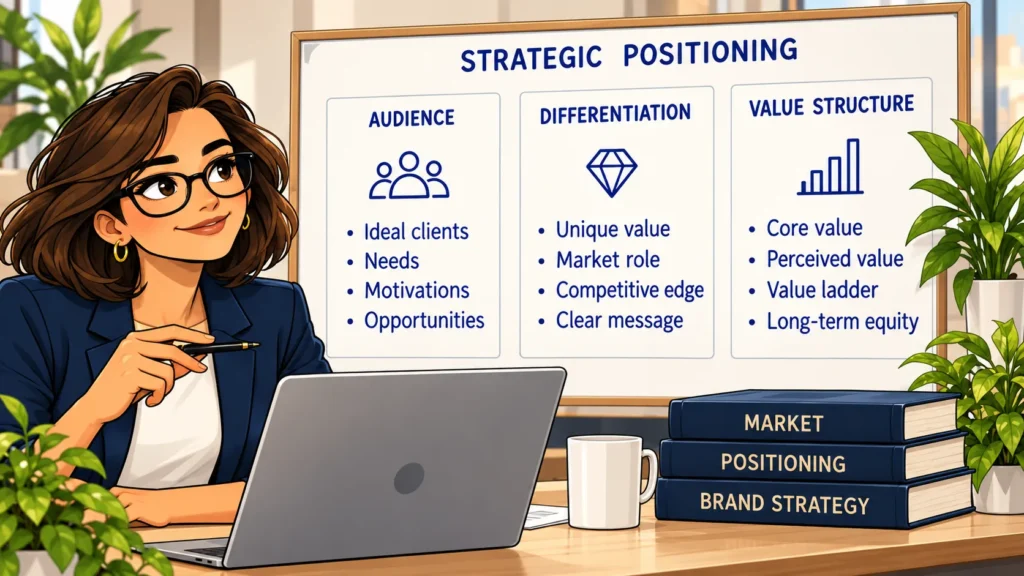
The deliberate definition of a company’s market role, differentiation, and value structure.
Monetization Architecture

The structure of offers, pricing, and revenue systems that transforms positioning into predictable income.
Decision Architecture

The way strategic communication and offer design guide clients toward confident, high-value decisions.